Convincing children that a trip can be both educational and enjoyable is often a delicate negotiation. Mention the word “learning” during school holidays and enthusiasm can quickly fade. Yet across India, there are destinations where curiosity replaces boredom and history, science and culture come alive in ways that feel anything but academic.
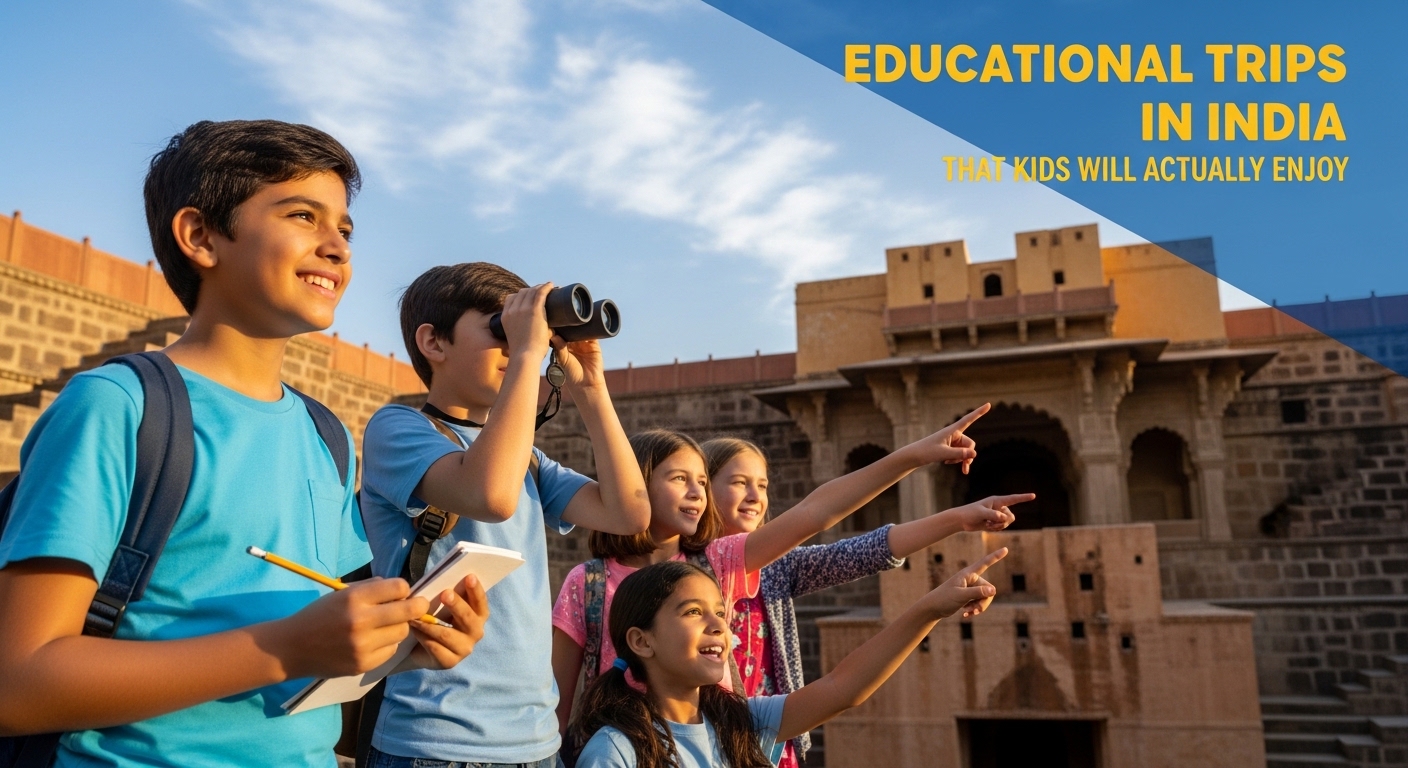
The key lies in choosing places where stories unfold visually, experiments invite participation and landscapes themselves become classrooms. From space research centres to wildlife reserves and living heritage cities, India offers educational trips that children genuinely look forward to.
Jaipur: Astronomy and Royal History
Jaipur is often admired for its pink facades and royal palaces, but it also offers a hands-on introduction to astronomy. The Jantar Mantar, a UNESCO World Heritage Site, features massive stone instruments built in the eighteenth century to measure time and track celestial bodies.
For children, seeing a giant sundial that still tells accurate time can be far more engaging than reading about it in a textbook. Guides often demonstrate how shadows shift across the marble surface, turning abstract science into something tangible.
Beyond astronomy, the City Palace and Amber Fort introduce young travellers to stories of kings, queens and courtly life. Armour displays, courtyards and hidden passages transform history into an adventure narrative rather than a list of dates.
Jaipur’s blend of science and storytelling makes it a strong candidate for an educational family getaway.
Ahmedabad: Innovation at the Science City
For children fascinated by experiments and technology, Gujarat Science City in Ahmedabad is a dynamic stop. Spread across a vast campus, it features interactive exhibits, robotics displays, an IMAX theatre and a hall dedicated to space science.
Unlike static museums, many installations here encourage participation. Children can engage with physics experiments, explore virtual reality experiences and observe scientific principles in action.
Ahmedabad also offers lessons in architecture and history. The Sabarmati Ashram provides insight into India’s freedom movement, presented in a calm and accessible format that older children can appreciate.
A trip to Ahmedabad combines curiosity with context, allowing families to explore both innovation and heritage.
Hyderabad: Space and Civilisation
Hyderabad stands out for its blend of cutting-edge science and rich history. The Birla Science Museum offers exhibits on physics, biology and space, along with a planetarium show that can ignite fascination with the cosmos.
For children interested in rockets and satellites, a visit to the nearby Satish Dhawan Space Centre, when accessible through organised tours, provides insight into India’s space missions. Even learning about the centre’s role can inspire young minds.
At the same time, the historic Golconda Fort introduces lessons in medieval engineering and acoustics. Demonstrations of how sound travels from the entrance gate to the highest pavilion never fail to surprise children.
Hyderabad shows that education can span centuries, from ancient fortifications to modern space exploration.
Mysuru: Culture and Nature
Mysuru offers a more traditional yet equally engaging educational experience. The Mysore Palace captivates children with its grandeur, stained glass ceilings and royal artefacts.
The city’s zoo, one of the oldest in India, is well maintained and organised. It provides an opportunity for children to observe wildlife up close while learning about conservation.
Nearby, the Ranganathittu Bird Sanctuary offers boat rides through wetlands where migratory birds’ nest. Watching painted storks and pelicans in their natural habitat creates a connection to environmental awareness that no classroom slideshow can replicate.
Mysuru’s calm pace allows families to explore without rushing, making learning feel organic.
Agra: Architecture and Empires
Few monuments capture a child’s imagination like the Taj Mahal. Its symmetry and scale prompt immediate curiosity. Why was it built? How were the marble blocks transported? How did craftsmen create intricate inlay patterns?
Explaining the story of Shah Jahan and Mumtaz Mahal turns the monument into a narrative of love and craftsmanship. The nearby Agra Fort adds layers of political intrigue and architectural innovation.
For older children, discussing the Mughal Empire’s influence on art and urban planning can deepen understanding. Seeing these sites firsthand makes history less distant and more relatable.
Jaisalmer: Desert Ecology and Living Forts
Jaisalmer offers lessons in geography and sustainability. The Jaisalmer Fort, one of the few living forts in the world, still houses residents within its sandstone walls.
Children can learn how desert communities adapted to scarce water resources, building stepwells and designing homes to remain cool. Camel rides in the Thar Desert provide insight into local livelihoods and ecosystems.
The desert landscape itself becomes a classroom, demonstrating how flora and fauna survive in extreme conditions.
Kaziranga: Wildlife Conservation
For families eager to introduce children to biodiversity, Kaziranga National Park offers an immersive experience. Home to the one horned rhinoceros, the park’s grasslands and wetlands teem with wildlife.
Jeep safaris allow children to observe elephants, deer and numerous bird species in their natural environment. Rangers often explain conservation efforts and the importance of protecting endangered animals.
Witnessing wildlife outside a zoo setting fosters a deeper appreciation for ecosystems. It also sparks conversations about environmental responsibility.
New Delhi: Museums and Democracy
India’s capital is rich in museums designed to engage young minds. The National Science Centre features interactive displays that encourage experimentation. The Rail Museum showcases historic locomotives, often a favourite among children.
A visit to Rashtrapati Bhavan or a walk around India Gate introduces basic concepts of governance and national history. For older students, the Parliament Museum can offer insights into democratic processes.
Delhi’s variety allows families to customise their educational itinerary according to age and interest.
Making Educational Trips Enjoyable
The success of an educational trip depends less on the destination and more on approach. Short guided tours, interactive exhibits and storytelling help maintain engagement. Allowing children time to explore at their own pace prevents fatigue.
Balancing learning with leisure is essential. After a morning at a museum or monument, an afternoon in a park or local market can provide relaxation. Food also plays a role. Sampling regional cuisine turns geography into a sensory experience.
Encouraging children to ask questions and reflect on what they observe makes the trip participatory. A simple travel journal or sketchbook can transform observations into memories.
Learning Beyond the Classroom
India’s diversity offers countless opportunities for experiential learning. A fort becomes a lesson in architecture. A wildlife sanctuary introduces ecology. A science museum ignites curiosity about physics. A palace reveals cultural traditions.
Educational travel need not feel formal. When children see, touch and experience what they are learning, knowledge becomes personal.
In a country as layered as India, the world itself becomes a classroom. And when learning feels like discovery rather than obligation, children not only enjoy the journey. They remember it.