When Indians think of island holidays, the conversation almost always turns to turquoise waters and coral reefs in the Andaman. Yet India’s coastline stretches over 7,500 kilometres, and scattered along it are islands that remain largely absent from glossy brochures. These are places where fishing boats outnumber cruise liners, where sunsets are watched in silence, and where the rhythm of life is still dictated by tides.
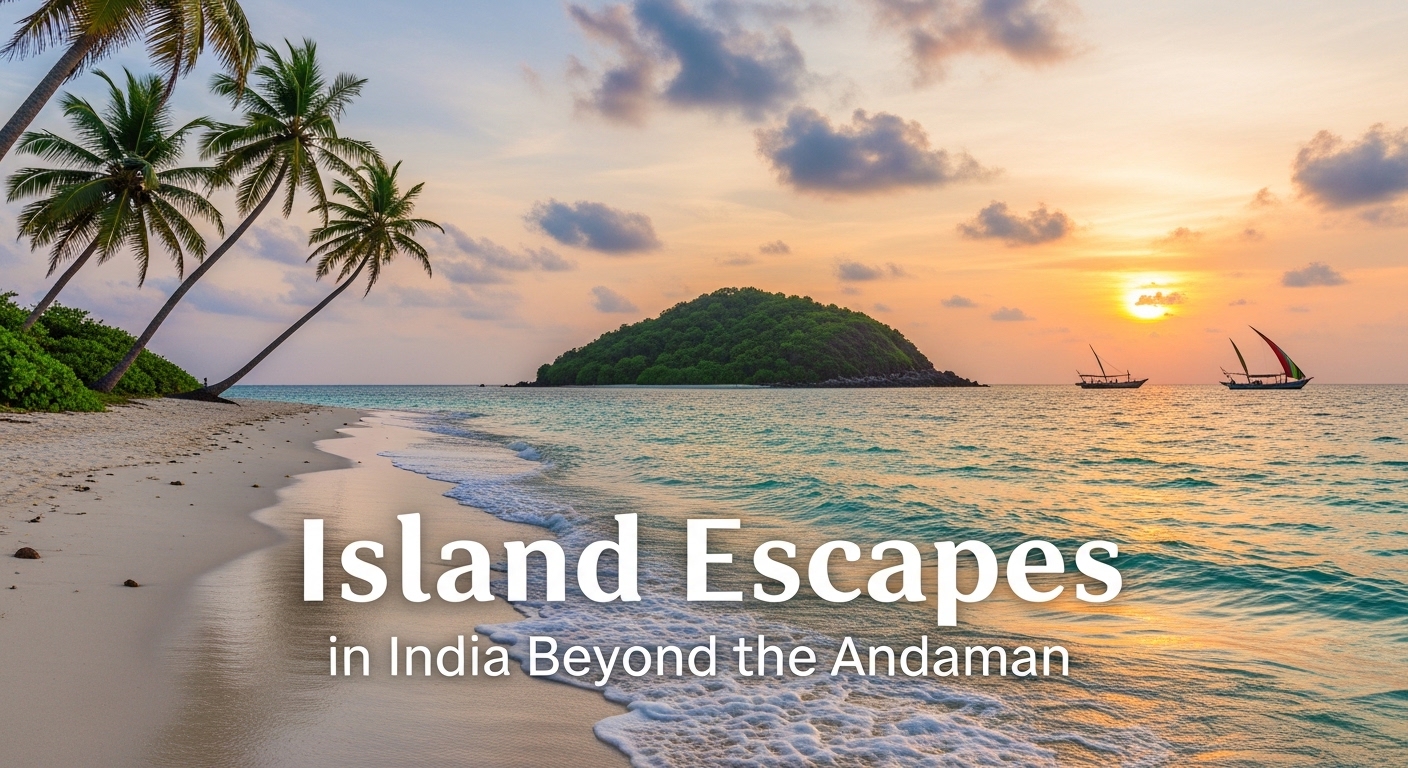
Beyond the Andaman archipelago lies a quieter world of island escapes that reward those willing to look past the obvious.
Diu, Diu
Off the southern coast of Gujarat, Diu feels like a relic of another era. Once a Portuguese colony, the island carries vestiges of European influence in its architecture and street names. Yet it is the sea that defines Diu’s mood.
The imposing Diu Fort stands against crashing waves, its stone walls weathered by centuries of salt and wind. From its ramparts, one can watch fishing boats return at dusk, their silhouettes etched against an orange sky.
Unlike busier beach destinations, Diu’s shores remain unhurried. Nagoa Beach stretches in a gentle curve, lined with palm trees rather than high rise hotels. Inland, narrow lanes lead to pastel coloured churches and modest homes where local families have lived for generations.
Diu’s appeal lies in its balance. It offers history, solitude and the reassuring familiarity of Gujarati cuisine, all within a compact island setting.
Divar Island, Divar Island
A short ferry ride from Panaji transports visitors to Divar Island, a place that feels worlds away from Goa’s party image. Here, winding roads pass through paddy fields and sleepy villages.
Whitewashed churches punctuate the landscape, including the serene Our Lady of Compassion Church. Houses painted in soft blues and yellows sit behind low walls adorned with bougainvillea.
Divar’s magic lies in its stillness. There are no beach shacks blaring music, no crowds chasing sunsets. Instead, you find fishermen mending nets, children cycling along quiet lanes and elders exchanging stories under banyan trees. During the monsoon, the island turns lush and intensely green, offering a different kind of coastal beauty.
For travellers who crave Goa’s heritage without its noise, Divar provides an intimate escape.
Majuli, Majuli
Far from the sea, in the mighty Brahmaputra River, lies Majuli, one of the world’s largest inhabited river islands. Reaching it requires a ferry ride from Jorhat, and the journey itself feels like a rite of passage.
Majuli is not about beaches or luxury resorts. It is about culture and resilience. The island is home to several satras, or Vaishnavite monasteries, established in the 16th century. At places like Kamalabari Satra, monks continue traditions of dance, music and manuscript painting that have survived centuries.
Life here revolves around the river. Bamboo houses are built on stilts to withstand floods. Farmers tend to fields that are reshaped each year by shifting waters. Sunset on Majuli is a quiet spectacle, with golden light reflecting off sandbanks and grazing cattle.
In a world obsessed with tropical clichés, Majuli offers a contemplative island experience rooted in faith and folklore.
St. Mary’s Islands, St. Mary’s Islands
Off the coast of Udupi in Karnataka, a cluster of four small islands rises from the Arabian Sea. St. Mary’s Islands are geologically unique, known for their striking basalt rock formations.
These columnar structures, formed by volcanic activity millions of years ago, create a dramatic seascape unlike any other in India. Visitors arrive by boat, often spending a few hours exploring the rocky shoreline and watching waves crash against dark stone pillars.
There are no resorts here, no permanent settlements. The islands are protected, and their raw beauty remains largely untouched. The experience is brief but memorable, a reminder that island escapes can be defined as much by geology as by palm fringed beaches.
Pamban Island, Pamban Island
Connected to mainland Tamil Nadu by the iconic Pamban Bridge, Pamban Island carries both spiritual and scenic significance. It is home to the pilgrimage town of Rameswaram, yet beyond the temple crowds lies a quieter coastline.
The drive across the bridge is itself unforgettable. Turquoise waters stretch on either side, dotted with fishing boats. On clear days, the sea appears almost translucent.
Dhanushkodi, located at the island’s tip, is a hauntingly beautiful ghost town destroyed by a cyclone in 1964. Today, its ruined church and railway station stand against vast stretches of sand and sea. The landscape feels cinematic, expansive and elemental.
Pamban Island offers a blend of devotion and desolation, making it one of India’s most evocative island journeys.
Lakshadweep, Lakshadweep
While often overshadowed by the Andaman, Lakshadweep is an archipelago of coral atolls scattered in the Arabian Sea. Its islands are smaller, more intimate and carefully regulated to protect fragile ecosystems.
Agatti, Bangaram and Kadmat are among the inhabited islands that welcome visitors. Here, lagoons shimmer in shades of blue that rival any tropical destination. Coconut palms sway gently above powdery sand, and coral reefs teem with marine life.
What distinguishes Lakshadweep is its restraint. Tourism is controlled, preserving both the environment and the islanders’ way of life. Days are spent snorkelling, kayaking or simply watching the horizon dissolve into sky.
In Lakshadweep, luxury is defined not by opulence but by clarity of water and quiet of mind.
Munroe Island, Munroe Island
Tucked within Kerala’s backwaters near Kollam, Munroe Island is a network of canals, lagoons and narrow strips of land. It offers an island experience shaped by freshwater rather than open sea.
Traditional wooden boats glide past coconut groves and small homes perched along the water’s edge. Early mornings bring fishermen casting nets and women washing clothes by the canal.
Munroe Island’s charm lies in its intimacy. Homestays allow visitors to share meals with local families, sampling fish curry and tapioca prepared with care. Evenings are marked by the soft glow of lamps and the distant sound of temple bells.
Here, the island escape is not about dramatic vistas but about immersion in everyday life.
A Different Definition of Paradise
These islands challenge the notion that an ideal escape must involve international flights or luxury resorts. They remind travellers that solitude can be found in a ferry ride away from a familiar city, in a river island shaped by faith, or in a rocky outcrop sculpted by ancient lava.
From the colonial echoes of Diu to the monastic calm of Majuli, from the geological drama of St. Mary’s Islands to the coral serenity of Lakshadweep, India’s lesser-known islands offer diverse narratives.
In choosing to explore beyond the Andaman, travellers discover that the true wealth of India’s islands lies not only in their beaches but in their stories. Each tide carries history. Each shoreline holds memory. And each island, in its own quiet way, invites you to pause and listen.