Every spring, as winter recedes and mustard fields glow across northern India, a festival erupts that is unlike any other. Holi is not simply a celebration of colour. It is a ritual of renewal, a playful defiance of social boundaries, and a reminder that joy can be collective. Streets turn into open stages. Strangers smear gulal on one another’s faces. Drums echo through old lanes. Sweet shops sell gujiya by the kilo.
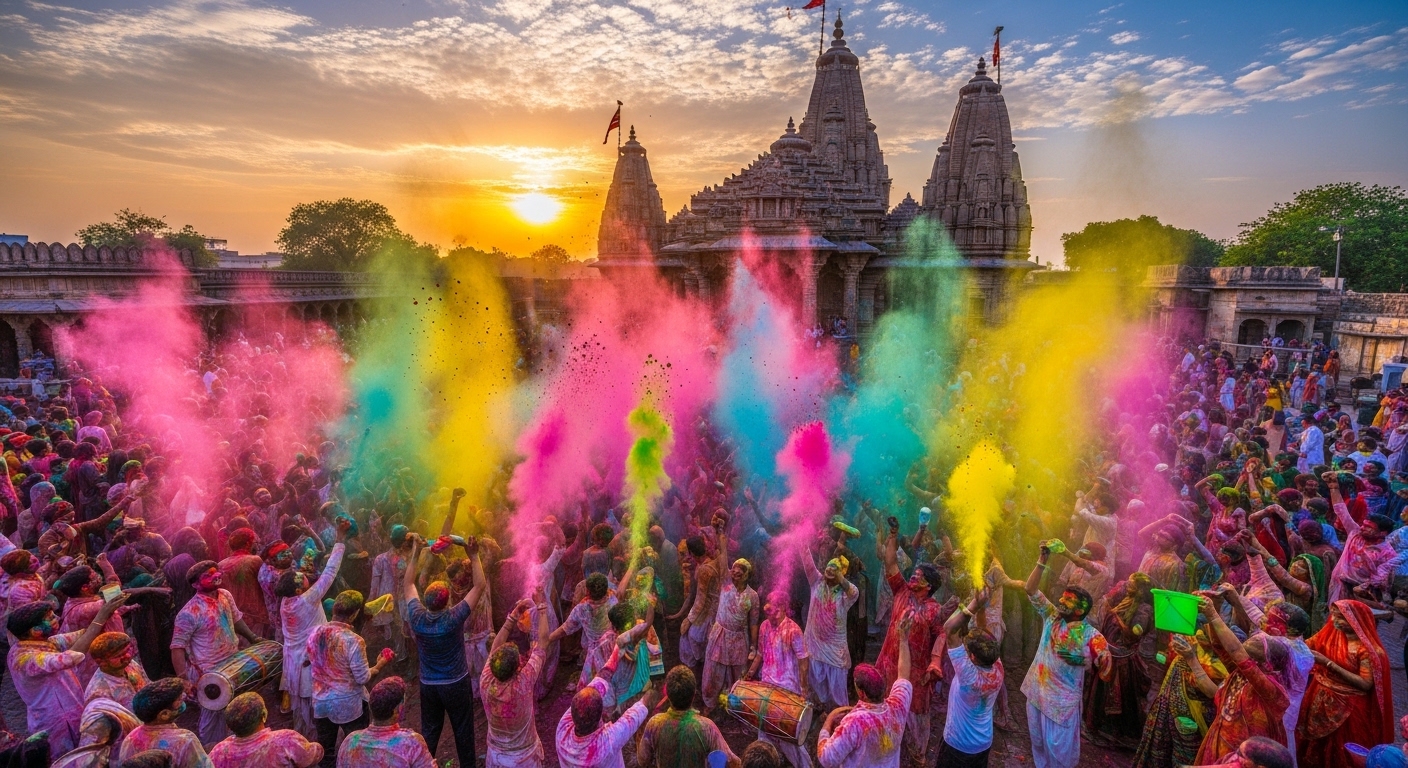
Yet Holi is not the same everywhere. Across India, different regions shape the festival through myth, history and local temperament. Some celebrate with devotion, others with theatrical flair, and a few with an intensity that can surprise first time visitors. For travellers who wish to experience Holi beyond photographs, these destinations offer the most vivid celebrations.
Mathura and Vrindavan
If Holi had a spiritual capital, it would be Mathura and neighbouring Vrindavan. These twin towns in Uttar Pradesh are deeply associated with Lord Krishna, whose playful legends form the heart of Holi traditions.
In the days leading up to the main festival, temples such as the Banke Bihari Temple host elaborate celebrations. Priests shower devotees with colours inside temple courtyards. Devotional songs fill the air. The atmosphere is devotional yet exuberant.
One of the most striking events here is Phoolon ki Holi, where flowers rather than coloured powder are tossed over worshippers. In Barsana, near Mathura, women enact Lathmar Holi, playfully striking men with sticks in a reimagining of Krishna’s teasing of Radha and her friends. The ritual is theatrical but rooted in centuries old tradition.
Holi in this region is immersive and intense. Crowds swell, chants rise, and colour seems to hang permanently in the air. For travellers seeking authenticity and mythological depth, Mathura and Vrindavan offer an unmatched experience.
Jaipur
In Rajasthan’s capital, Holi blends royal legacy with vibrant street celebration. Jaipur’s sandstone buildings provide a dramatic backdrop for bursts of pink, yellow and green.
The festival often begins with a traditional Holika Dahan, where bonfires are lit to symbolise the triumph of good over evil. In some years, the royal family of Jaipur has hosted public celebrations at the City Palace, featuring folk dances, music and ceremonial rituals.
On the streets, however, the mood is playful and energetic. Residents gather in neighbourhoods to exchange colours and sweets. Tourists are welcomed warmly, though it is wise to join organised events or celebrate within trusted circles.
Jaipur’s Holi balances spectacle and structure. The city’s heritage hotels and cultural organisations frequently host curated celebrations that allow visitors to participate safely while witnessing Rajasthani music and dance traditions.
Varanasi
Holi in Varanasi carries a raw and spiritual edge. Set along the banks of the Ganga, this ancient city celebrates with a fervour that reflects its layered identity.
On the eve of Holi, bonfires burn in neighbourhood squares. The following morning, narrow lanes erupt in colour. Processions move toward the ghats, where music and laughter blend with the constant flow of the river.
Unlike more organised celebrations, Varanasi’s Holi can feel spontaneous and chaotic. Drums beat rhythmically, bhang infused drinks are shared, and strangers become companions for a day. The city’s intensity amplifies the festival’s emotional charge.
For travellers willing to navigate crowds and noise, Varanasi offers a deeply atmospheric Holi. The sight of colour rising against centuries old temples and drifting across the river is unforgettable.
Udaipur
If Varanasi is raw, Udaipur is regal. The City of Lakes celebrates Holi with a combination of royal ceremony and community spirit.
The highlight is often the Holika Dahan ceremony at the City Palace. Traditionally attended by members of the Mewar royal family, the event features a procession with horses, traditional attire and ceremonial rituals.
The following day, the mood shifts to celebration. Residents gather in streets and courtyards to exchange colours. Compared to larger cities, Udaipur’s Holi can feel more relaxed, with its lakefront setting adding an element of charm.
For visitors seeking a blend of heritage and festivity, Udaipur offers a balanced experience. Its architecture and lakeside vistas create a picturesque frame for the riot of colours.
Delhi
India’s capital city celebrates Holi in many forms. From traditional neighbourhood gatherings to large scale music festivals, Delhi offers options for every temperament.
In residential colonies, families celebrate with water balloons, coloured powder and home cooked sweets. Meanwhile, ticketed Holi parties feature DJs, dance floors and organic colours, attracting younger crowds.
Areas like Hauz Khas and South Delhi often host organised events in open spaces or farmhouses. For travellers, joining a curated celebration can provide both safety and structure, especially in a city known for its scale.
Delhi’s Holi is cosmopolitan. It brings together people from across India, each adding their regional flavour to the mix. The result is a festival that feels diverse and energetic.
Shantiniketan
In West Bengal, Holi takes on a more artistic expression in Shantiniketan, the university town founded by Rabindranath Tagore. Here, the festival is known as Basanta Utsav.
Students dress in shades of yellow and perform songs and dances inspired by Tagore’s compositions. Instead of chaotic colour throwing, the celebration unfolds with cultural performances, poetry and controlled use of gulal.
The emphasis is on spring and renewal rather than exuberant play. Visitors often find Shantiniketan’s Holi refined and aesthetically pleasing. It is an ideal destination for those who prefer culture over chaos.
Anandpur Sahib
In Punjab, Holi coincides with Hola Mohalla, a festival initiated by Guru Gobind Singh. Celebrated at Anandpur Sahib, it showcases Sikh martial arts, processions and community gatherings.
Nihang warriors demonstrate traditional combat skills, riding horses and performing daring feats. Langars serve free meals to thousands of visitors. While colour plays a smaller role here, the spirit of collective celebration remains strong.
Hola Mohalla offers a different lens through which to view the season. It emphasises courage, community and service rather than playful colour battles. For travellers interested in Sikh history and tradition, it is a compelling experience.
Choosing the Right Holi Experience
Holi is joyous but can also be overwhelming. Crowds are large, and the atmosphere is spirited. Visitors should wear clothes they do not mind staining, protect their eyes, and respect local customs. Joining celebrations through reputable hotels or cultural groups can enhance safety and understanding.
Each city offers a distinct interpretation of the festival. Mathura and Vrindavan root it in mythology. Jaipur and Udaipur add royal flair. Varanasi infuses it with spiritual intensity. Delhi modernises it. Shantiniketan refines it. Anandpur Sahib redefines it.Holi endures because it speaks to something universal. The act of colouring another person erases distance. Laughter dissolves hierarchy. For a brief moment, life feels lighter.
Across India, when March arrives and drums begin to beat, the country seems to exhale winter and inhale spring. In that burst of colour, travellers do not just witness a festival. They become part of it.